
Addiction Awareness and Intervention Training
This self-paced certificate training provides comprehensive, practical, research-backed skills to recognize warning signs, respond with confidence, and support recovery


What's Included
In-Depth, Evidence-Based Curriculum
40+ video and written lessons (5 hours in total)
Learn on Your Schedule
Fully online and self-paced. Access anytime, from anywhere. Pause and return whenever you like.
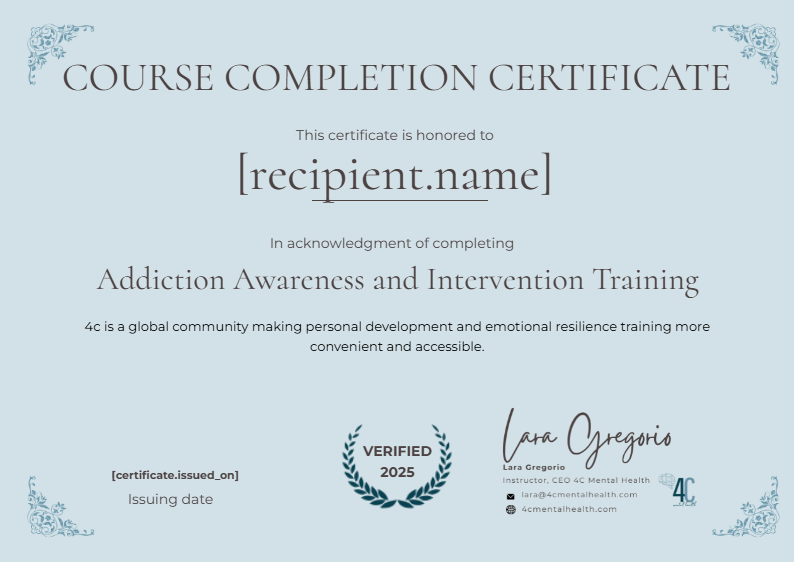
Certificate of Completion
Earn your Addiction Awareness and Intervention certificate—no prior experience required.
Transformative skills whether you're a teacher, volunteer, healthcare provider, advocate, faith leader, peer supporter — or simply someone who cares deeply about the people in your life.
Couldn't load pickup availability
What happens after enrollment? Instant access from any device.
View full details

What You’ll Learn
Inside this training, you’ll learn:
- Why addiction isn’t about willpower—and what’s actually happening in the brain.
- How to recognize early warning signs and know when intervention is appropriate.
- How to communicate in a way that increases the likelihood of positive change.
- How to set boundaries without guilt or fear.
- How to support others without burning yourself out.
- Practical, evidence-based approaches for intervention and recovery support.
Every lesson is grounded in psychology, neuroscience, CBT, and DBT—translated into real-world tools you can actually use. Designed to be simple, easy to understand, and engaging, each lesson takes under 5 minutes, and you can pause and return anytime.
All On-Demand, in Multi-media engaging lessons
Course Outline
Module 1: What Is Addiction? A Scientific and Psychological Perspective
- Is Addiction a Disease or a Choice? (Spoiler: It’s Complicated)
- Common Myths About Addiction — and the Truth Behind Them
- The Three Big Factors That Shape Addiction: Biology, Psychology, and Environment
Module 2: Understanding the Biology
- The Biological Factors — Your Brain and Your Genes
- What’s Happening in the Brain During Addiction?
- The Neuroscience of Dopamine
- Why an Addict Feels “Blah”
- There Is Hope: The Brain Can Heal
Module 3: Addiction Through a Psychosocial Lens
- Learning to Feel Again
- The Psychological and Emotional Aspects of Addiction
- Rethinking Addiction Through Social Context
- Co-Occurring Disorders: When Mental Health and Addiction Intersect
- Trauma and Its Connection to Addiction
- Social and Environmental Factors That Contribute to Addiction
Module 4: Recognizing the Signs and Symptoms
- Is It Just a Phase… or Something More?
- Podcast: Warning Signs of Addiction
- How Do You Know When It’s Time to Be Concerned?
Module 5: How Addiction Affects Families and Loved Ones
- A Narrated Personal Account: Living Beside Addiction
- Common Emotional Responses to a Loved One’s Addiction
- Setting Boundaries and Avoiding Enabling Behaviors
Module 6: Interventions — Motivation Enhancement
- Understanding Motivation and Behavior Change
- Helping Others Move Through the “Stuck” Stage
- Motivational Enhancement and the Stages of Change
- Using the Stages of Change Framework
- Cheat Sheet: Questions You Can Use to Assess and Drive Motivation
- OARS Framework: Open Questions, Affirmations, Reflections, and Summaries
Module 7: Interventions — Harm Reduction
- The Foundations of Harm Reduction
- Practical Harm Reduction Strategies for Everyday Life
Module 8: Leading with Empathy — Tools to Connect and Support
- Active Listening
- Listening to Understand
- Listening, Not Fixing
- A Poem on Listening
- Practicing Empathy for Those Struggling with Addiction
Module 9: Compassionate Listening Skills
- The Power of Validation
- Highlighting Strengths
- A Simple 3-Step Strategy for Connection
- More Active Listening Techniques
- Starting the Conversation
- Podcast Episode: Initiating the Conversation
Module 10: Self-Care Is Crucial
- Take Care of Yourself, Too
Learn to set boundaries, process difficult emotions, and build resilience while supporting others.
FAQs
How is this course delivered?
This training is delivered fully online through the 4C Learning Hub.
You’ll have access to self-paced video lessons, short readings, practical exercises, and reflection prompts. You can move through the material at your own pace and revisit lessons anytime while your membership is active.
Does this training lead to certification, licensure, or job placement?
This course does not provide licensure or job placement.
However, many learners use it to:
- Strengthen their effectiveness in caregiving, education, or community roles
- Prepare for future work or study in mental health or social services
- Add foundational addiction knowledge to peer support, advocacy, or volunteer work
The focus is on real-world competence, not credentials.
Who is this program for?
This training is designed for:
- Family members or loved ones of someone struggling with addiction
- Peer supporters, mentors, and community helpers
- Educators, faith leaders, and nonprofit staff
- Anyone who wants to understand addiction more clearly and respond more effectively
No prior experience or background in mental health is required.
Will I receive a certificate?
Yes. Upon completion, you’ll receive a certificate of completion recognizing your training in addiction awareness and support.
This certificate reflects education and skill-building—not clinical qualification—and may be used for personal development, volunteer roles, or professional learning documentation.
How do I access the course?
After you join, you’ll receive immediate access to the 4C Learning Hub.
From there, you can:
- Log in anytime from your computer or mobile device
- Navigate directly to the Addiction Awareness & Support course
- Start lessons right away or return to them whenever it fits your schedule
All course materials live inside the Learning Hub and remain available while your membership is active.