


Trauma-Informed Support Training
Trauma-Informed Support Training
This powerful training draws from psychology, neuroscience, and evidence-based trauma frameworks, equipping participants with the knowledge and skills to understand trauma responses and offer grounded, compassionate support.
This training is for anyone who wants to better understand trauma responses—fight, flight, freeze, and fawn—and learn how to communicate and show up in ways that reduce harm and foster resilience.
Couldn't load pickup availability


What’s Included
- 40+ video and written lessons
- 3-5 hours total training time
- Learn at your own pace — pause and return anytime
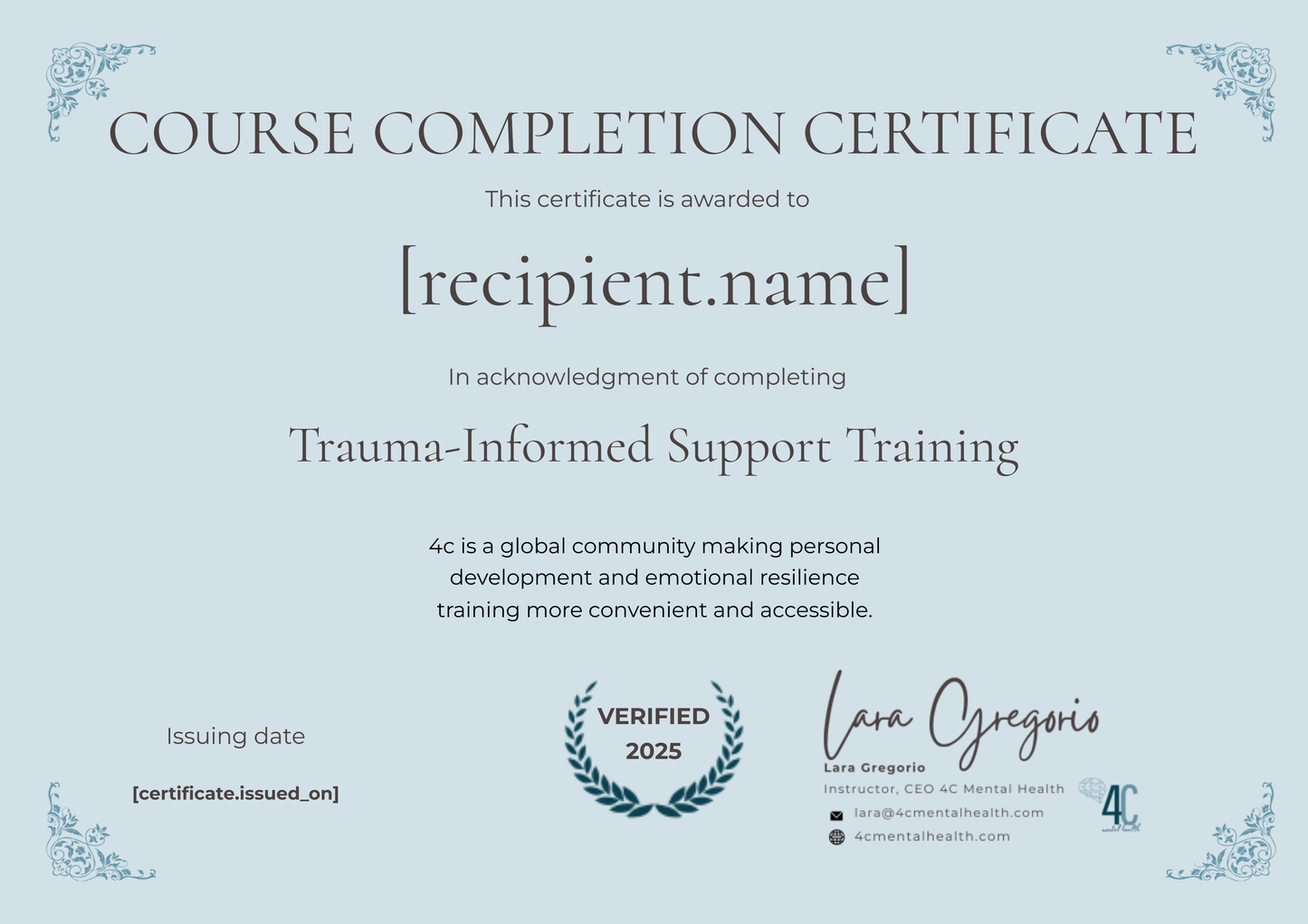
- Earn a certificate upon completion
Gain a deeper understanding of how trauma impacts the brain and nervous system, learn practical grounding and regulation strategies, and build confidence supporting others with safety, clarity, and respect.
All On-Demand, in Multi-media engaging lessons
Course Outline
Section 1: Introduction to Trauma
In this first section, we’ll cover foundational ideas about trauma—what it is, where it comes from, and why it matters to learn about it with both heart and clarity.
Section 2: The Neuroscience of Trauma
In this section, we’ll explore what trauma actually does to the brain and nervous system. You’ll learn how our most basic survival systems—fight, flight, freeze, and fawn—kick in to protect us, and how those systems can get stuck in overdrive long after the danger has passed.
We’ll break down how trauma impacts three key areas of the brain:
- The amygdala (our alarm system)
- The hippocampus (our memory filer)
- The prefrontal cortex (our reasoning and regulation center)
We’ll also introduce the basics of polyvagal theory, which helps explain why trauma survivors may feel hijacked by panic, disconnection, or shutdown—without choosing it.
Most importantly, we’ll unpack this truth:
Trauma is not just a memory. It’s a felt experience, often stored in the body even when the mind can’t fully explain it.
By the end of this section, you’ll better understand the why behind trauma responses—and be more equipped to respond with compassion, not confusion.
Section 3: The Psychology of Trauma
How Trauma Shapes Identity, Relationships, and the Way We See the World
Trauma can shift how we think, feel, relate, and exist. It can distort a person’s sense of self, fracture trust in others, and create a world that feels permanently unsafe—even long after the danger has passed.
This section explores the psychological layers of trauma, focusing on how it affects our core beliefs, identity, attachment patterns, and interpersonal behavior. You’ll also learn how the dose of trauma—the frequency, intensity, and timing—affects long-term mental and emotional functioning.
Key ideas we’ll explore:
- The Fawn Response and other relational survival strategies
- Attachment wounds and how early trauma shapes adult relationships
- The concept of a "trauma lens": how people come to interpret the world around them
- Dose matters: why multiple or early traumas are harder to shake
- The emotional toll of betrayal trauma, stigma, and systemic invalidation
- How trauma alters a person’s inner voice, boundaries, and self-worth
Section 4: Community-Level Trauma
This section invites you to widen your lens. Here, we explore how trauma is shaped—and sometimes sustained—by the world we live in: by structural injustice, cultural expectations, and the stigmas that silence survivors. Understanding these layers helps us move from individual support to systemic healing—and ensures that no one is left behind simply because their pain doesn’t fit the mold.
Section 5: From Understanding to Action
In this next section, we’ll move from understanding trauma to showing up for others in a trauma-informed way.
You don’t have to be a therapist to make a difference.
You just need a few key tools, and the ability to meet people with presence, compassion, and skill.
Section 6: Trauma-Informed Toolkit: Practical Tools for Support and Resilience
This section is your Toolkit—a collection of simple, powerful techniques that anyone can use to:
- Regulate emotions during moments of overwhelm
- Build distress tolerance when things can’t immediately be changed
- Strengthen resilience through daily habits and internal resources
- Offer effective, trauma-informed support to others
- Reclaim a sense of safety, agency, and empowerment
These tools aren’t just for “in the moment” crisis management. They’re also about long-term healing—offering people ways to reconnect with their bodies, shift their stories, and move toward growth. Whether you’re using them for yourself or offering them to someone else, these techniques are meant to meet people where they are.
Some tools are body-based, others are conversation-based. Some are rooted in neuroscience, others come from ancient traditions. All are focused on building capacity—not control. We’re not trying to stop feelings from happening. We’re learning how to move through them, safely and skillfully.
FAQs
How is this course delivered?
This training is delivered fully online through the 4C Learning Hub.
You’ll have access to self-paced video lessons, short readings, practical exercises, and reflection prompts. You can move through the material at your own pace and revisit lessons anytime while your membership is active.
Does this training lead to certification, licensure, or job placement?
This course does not provide licensure or job placement.
However, many learners use it to:
- Strengthen their effectiveness in caregiving, education, or community roles
- Prepare for future work or study in mental health or social services
- Add foundational addiction knowledge to peer support, advocacy, or volunteer work
The focus is on real-world competence, not credentials.
Will I receive a certificate?
Yes. Upon completion, you’ll receive a certificate of completion.
This certificate reflects education and skill-building—not clinical qualification—and may be used for personal development, volunteer roles, or professional learning documentation.
How do I access the course?
After you enroll here, you’ll receive immediate access via email to the 4C Learning Hub.
From there, you can:
- Log in anytime from your computer or mobile device
- Start lessons right away or return to them whenever it fits your schedule
All course materials live inside the Learning Hub and remain available while your membership is active.